
How to hire 500 warehouse workers in 2 weeks (without burning out your team)
AI TRENDS
12 min read
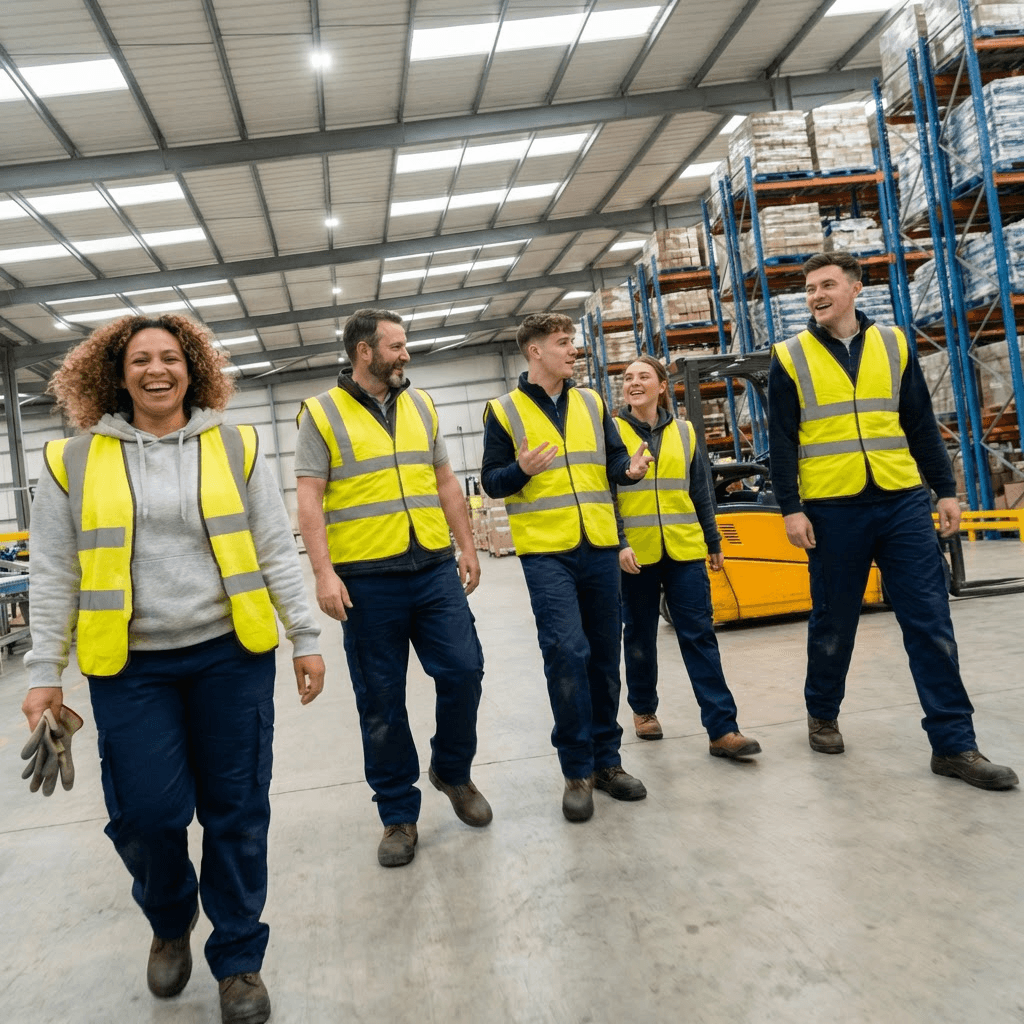
370,000 warehouse jobs sat unfilled in February 2025. That number was 15% higher than the year before. And peak season hadn't even started yet.
If you run warehouse operations, you already know what this feels like. Roles that need filling yesterday. Recruiters buried in unqualified CVs. Candidates who disappear between the phone screen and the first shift. And a hiring process that was designed for 20 openings, not 200.
This article is a playbook. Not a think piece, not a trend report — a step-by-step guide to hiring hundreds of warehouse workers in weeks instead of months. It's based on real operational data, verified industry benchmarks, and how AI is changing the math for warehouse recruitment teams right now.
The warehouse hiring problem nobody talks about
Most articles about warehouse staffing start with "there's a labor shortage." That's true, but it's not the whole story.
The real problem is a timing gap. The average time-to-hire for warehouse roles is 18 days. But the best candidates are off the market within 10 days. That's an 8-day gap where your top applicants are accepting offers somewhere else while your team is still scheduling phone screens.
And the numbers behind that gap are brutal.
Annual turnover in warehousing runs at 49% — nearly double the national average. Every departure costs roughly $18,600 when you add up recruitment, training, and lost productivity. That's not the $4,700 cost-per-hire figure most teams track. It's the full picture. And at 49% turnover, you're paying that cost for nearly half your workforce every year.
Then there's the quality problem. 75% of resumes submitted to high-volume job postings are unqualified. Three out of four. Your recruiters are spending their days reading CVs from people who don't meet the basic requirements. That's not recruiting. That's sorting mail.
There's a demographic dimension too. The median age for warehousing and logistics workers is now 45+. Younger generations aren't entering the field at the same rate. Deloitte and the Manufacturing Institute estimate that 1.9 million manufacturing and logistics jobs could go unfilled over the next decade if nothing changes. This isn't a seasonal shortage. It's a structural shift.
Why traditional warehouse recruitment breaks at scale
The tools most warehouse hiring teams use were built for a different era. They work fine when you're filling 5 roles. They collapse when you need 500.
A Phenom analysis found that 68% of companies still rely on manual hiring processes and struggle to scale efficiently. That means recruiters manually reviewing every CV, manually scheduling every phone screen, manually sending every follow-up email. Multiply that by 500 openings and the system doesn't slow down — it stops.
The bottlenecks are predictable. First, screening. Recruiters can realistically review 50-80 CVs per day with any real attention. When 1,000 applications come in for a warehouse operative role, the backlog starts on day one. Second, scheduling. Phone screens require coordination — callbacks, voicemails, timezone juggling, no-shows. Third, communication. Candidates waiting for updates don't wait long. 27% of talent acquisition leaders say their teams are overwhelmed by unmanageable workloads, up from 20% the prior year.
And then there's ghosting. In frontline hiring, 22% of candidates who accept an offer don't show up on the first day. Among Gen Z workers, 34% have "career catfished" — accepted a role only to vanish before starting. The longer the gap between application and start date, the higher the odds of a ghost.
The instinct is to throw more people at the problem. Hire more recruiters. Bring in an agency. But that doesn't fix the process — it just makes an expensive process more expensive. Amazon can hire 250,000 seasonal workers because they've automated the pipeline. Most warehouse operations don't have that infrastructure. Until now.
What hiring 500 warehouse workers in 2 weeks actually requires
Before talking about solutions, it's worth understanding the operational reality of warehouse hiring at scale.
Hiring 500 workers in two weeks means processing thousands of applications. Not all 500 will come from the first 500 who apply. With a 75% unqualified rate, you might need 2,000-3,000 applications to find 500 qualified candidates. And "qualified" in warehouse hiring means more than a matching CV. It means:
Shift availability. Can they work nights? Weekends? Rotating schedules?
Certifications. Forklift license? Hazmat training? Food handling?
Location. Can they get to the facility within a reasonable commute?
Physical requirements. Can they lift, stand, move for full shifts?
Start date. Can they begin this week, or do they need two weeks' notice?
In a traditional process, each of these questions requires a conversation. A phone screen. A back-and-forth. For 500 hires, that's 500 individual screening calls — each lasting 15-30 minutes, each requiring a recruiter's time, each adding days to the timeline.
Here's the traditional timeline for a single warehouse hire:
Days 1-3: Job posted, applications trickle in
Days 3-8: Recruiter reviews CVs, builds a call list
Days 8-14: Phone screens (3-5 per day per recruiter, assuming no-shows)
Days 14-16: Shortlist shared with hiring manager
Days 16-18: Offers extended
Days 18-21+: Onboarding paperwork, start date confirmed
That's three weeks for one hire. For 500 hires, you'd need an army of recruiters working in parallel — or you'd need to change the process entirely.
The three bottlenecks that kill speed are always the same: screening volume, interview scheduling, and candidate communication. Fix those three, and the timeline collapses.
How AI changes the warehouse hiring equation
AI doesn't make recruiters faster. It removes the bottleneck that makes them slow.
When AI handles screening, it doesn't review CVs one at a time. It processes thousands simultaneously. Every application is evaluated against the same criteria — shift availability, certifications, location, experience — in seconds, not days. There's no backlog. There's no "we'll get to these tomorrow."
When AI handles interviews, it doesn't schedule phone calls during business hours. It conducts structured screening interviews 24/7, in the candidate's preferred language, whenever they're available. The warehouse worker who finishes a shift at 10pm and applies on their phone at midnight? They can complete an AI interview before your recruiter wakes up.
When AI handles communication, candidates don't wait in silence. They know where they stand immediately after screening. No two-week gaps. No ghosting from your side.
And the consistency matters. Human recruiters — even good ones — are affected by fatigue, time pressure, and unconscious bias. The 50th CV reviewed at 4pm on a Friday doesn't get the same attention as the 5th CV reviewed at 9am on a Monday. AI applies the same criteria every time.
The data backs this up. A 3PL company with five distribution centers implemented AI-powered hiring and reduced time-to-hire from 42 days to 12 days. Recruiter admin time dropped by 75%. Candidate drop-off fell from 50% to 15%. And 90-day retention improved by 31%.
That last number is worth pausing on. Better screening doesn't just fill roles faster — it fills them with better-fit candidates who stay. When each departure costs $18,600, a 31% improvement in retention pays for the entire system many times over.
Other verified results from AI-powered warehouse recruitment:
Cost per hire dropped from ~$4,129 to ~$2,500 — a 40% reduction
Application completion rates jumped from 50% to 85%
Time-to-start for seasonal workers compressed from 12 days to 4 days
89% of HR professionals using AI for recruiting say it saves time or increases efficiency
These aren't projections. They're operational results from companies that have already made the switch.
The playbook: hiring 500 warehouse workers in 2 weeks
Here's what the compressed timeline looks like in practice.
Day 0: Define your criteria
Before anything moves, lock in what "qualified" means for each role. This isn't a job description exercise — it's a screening configuration.
Define:
Required certifications (forklift, OSHA, food safety)
Shift patterns and availability windows
Maximum commute distance or location radius
Physical requirements
Minimum experience thresholds (or none — some roles are entry-level)
Language requirements
The more specific you are here, the better AI can screen. Vague criteria produce vague results. Specific criteria produce a shortlist you can trust.
Days 1-2: Launch and screen
Post the roles. As applications come in, AI screens every single one — instantly. No backlog. No "we'll review these next week."
Each candidate is evaluated against your criteria in real time. Qualified candidates move forward immediately. Unqualified candidates are notified — no ghosting from your side either.
In a traditional process, this phase alone takes 5-8 days. With AI, it happens continuously from the moment you go live.
Days 2-5: AI interviews at scale
This is where the timeline really compresses.
Qualified candidates receive an AI interview invitation — by phone, on their schedule, in their language. The interview is structured: same questions, same evaluation criteria, same scoring for everyone.
The critical difference: these interviews run in parallel. Not 5 per day per recruiter. Hundreds. Simultaneously. A candidate who applies at 2am can complete their interview at 2:15am.
For warehouse roles, the interview covers:
Availability confirmation
Experience and certification verification
Motivation and role understanding
Logistics (commute, start date, shift preferences)
Every response is evaluated consistently. No fatigue bias. No "I liked the energy of candidate #3 but can't explain why."
Days 5-8: Rank and shortlist
AI has now screened and interviewed hundreds of candidates. It ranks them based on role fit — certifications, availability match, interview performance, experience relevance.
Your hiring team doesn't start from scratch. They start from a ranked shortlist. The top 50 candidates for each shift pattern, each location, each role type — ready for human review.
This is where the human judgment matters most. AI handled the volume. Your team handles the decisions.
Days 8-12: Offer and onboard
Offers go out to top-ranked candidates. Scheduling, document collection, and onboarding paperwork can be automated — no more chasing signatures or waiting for email replies.
Because candidates have already been screened and interviewed, the offer-to-start gap shrinks. They've already confirmed availability, verified certifications, and expressed commitment. The 22% no-show rate? It drops when the time between "I want this job" and "I start this job" is days, not weeks.
Day 14: Workers on the floor
500 warehouse workers. Two weeks. No recruiter burnout. No quality shortcuts.
The math works because AI eliminated the three bottlenecks: screening volume (handled in real time), interview scheduling (handled 24/7 in parallel), and candidate communication (handled instantly, no gaps).
How Clara handles warehouse hiring at scale
Clara is an AI recruiter built for exactly this kind of challenge. Not as a concept — as a daily operation for companies hiring hundreds of frontline workers.
Here's what Clara does:
Screens every application against your role criteria — instantly, 24/7
Interviews candidates by phone in 25+ languages, on their schedule
Ranks candidates based on role fit, interview performance, and availability
Schedules next steps automatically — no back-and-forth
And here's what Clara doesn't do: make hiring decisions. Clara screens, interviews, and ranks. Your team shortlists and hires. The final call is always human.
This distinction matters. For compliance, for trust, and for quality. AI handles the volume so your recruiters can focus on the judgment calls that actually need a human.
Clara works in 25+ languages with the same quality. The candidate in Madrid gets screened in Spanish. The candidate in Bucharest gets screened in Romanian. Same criteria, same evaluation, same speed. No need for bilingual recruiters or separate pipelines for each market.
And because Clara works around the clock, the night-shift candidate who can only talk after 9pm gets the same experience as the candidate who applies at 9am. In warehouse hiring, where shift workers have limited availability during business hours, that responsiveness is the difference between filling a role and losing a candidate to whoever called back first.
See how Clara works for warehouse and logistics hiring.
The bottom line
The warehouse labor gap isn't going away. Ecommerce is heading toward $6.88 trillion globally by 2026. The workforce is aging. Turnover stays near 50%. And 1.9 million logistics and manufacturing roles are at risk of going unfilled over the next decade.
Hiring faster isn't a nice-to-have. It's the strategy. The team that screens first, interviews first, and extends an offer first is the team that fills the role. Every time.
AI doesn't replace the hiring team. It removes the friction that makes the hiring team slow. Screening happens in real time. Interviews run in parallel. Candidates don't wait in silence. And recruiters spend their time on decisions, not data entry.
If your team is hiring dozens — or hundreds — of warehouse workers and the process still takes weeks, the bottleneck isn't talent supply. It's process.
AI hiring
Explore more articles

LEARN MORE
Ready to hire better people, faster?
Clara is fast to set up, and even faster to help you hire. Book a demo to learn more.