
Clara AI : Le moteur central derrière les décisions d'embauche plus intelligentes
PRODUIT
Lecture de 4 minutes

La plupart des outils de recrutement reposent sur des filtres de mots-clés et des règles binaires de réussite/échec. Cette approche élimine les nuances. Un candidat ayant quatre ans d'expérience au lieu de cinq est rejeté. Les compétences transférables sont négligées.
Clara AI fonctionne différemment.
Elle lit la description du poste, génère un entretien structuré, conduit l'appel et évalue chaque réponse par rapport à un barème défini. Les candidats sont classés de Peu adapté à Excellent.
Les recruteurs voient une liste restreinte classée avec des justifications claires et structurées — et non une pile de CV.
Comment Clara AI transforme une description de poste en une évaluation structurée
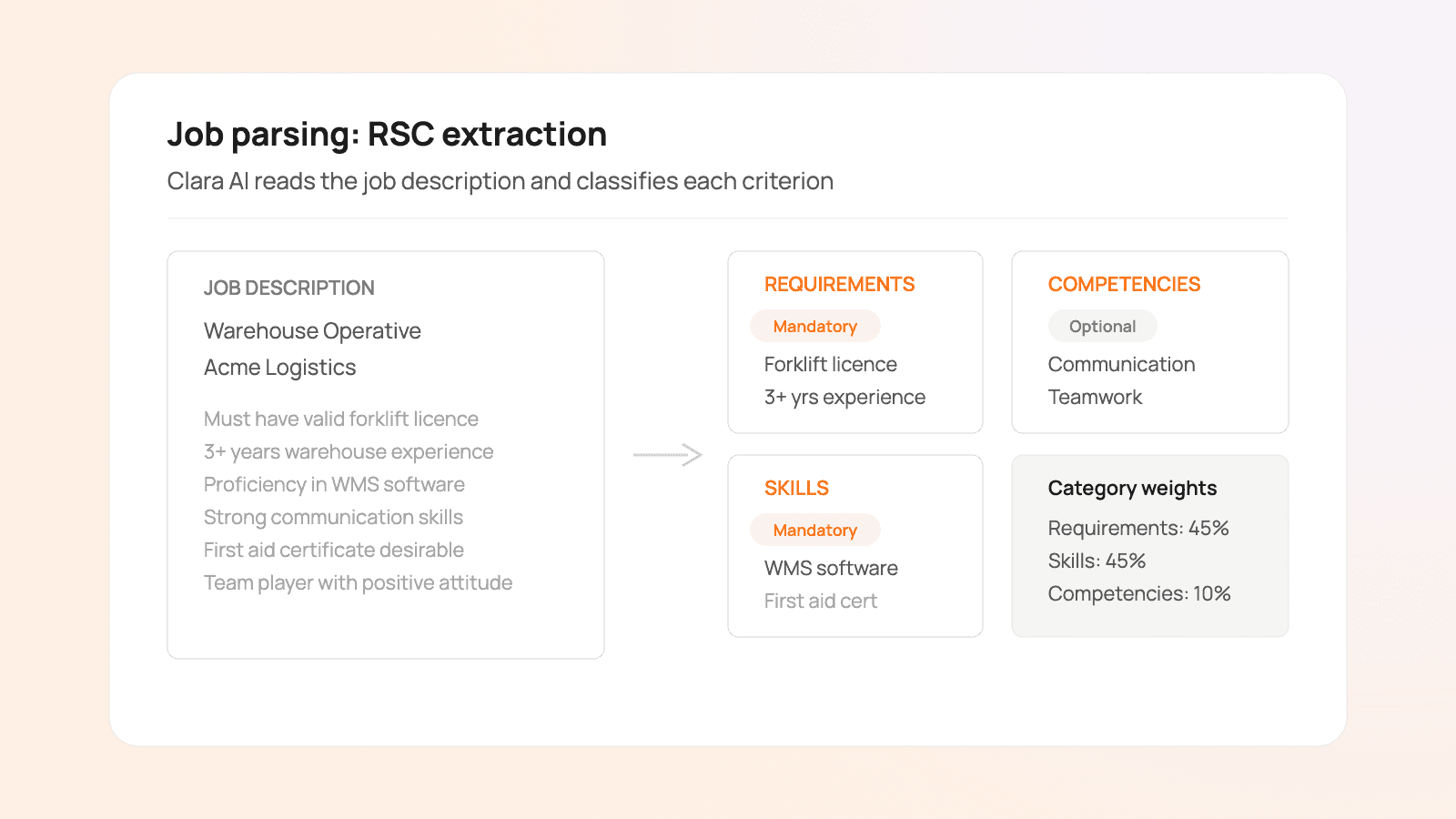
Lorsqu'un responsable du recrutement crée un rôle, Clara AI analyse la description du poste et extrait trois catégories de critères :
Exigences telles que l'éducation, les années d'expérience et les certifications
Compétences incluant les outils, les connaissances techniques et l'expertise dans le domaine
Compétences comme la communication, le travail en équipe et la résolution de problèmes
Chaque critère est classé comme obligatoire ou optionnel. Cette distinction est importante par la suite car elle détermine l'importance de chacun dans le score final.
À partir de là, Clara AI génère un script d'entretien complet. Les exigences obtiennent de 1 à 3 questions chacune, en fonction de la complexité. Les compétences et aptitudes obtiennent chacune une question ciblée. Chaque question est accompagnée d'un barème pré-généré : six niveaux de confiance de Excellent à Inadéquat, chacun avec une description personnalisée pour ce critère spécifique.
Ce barème est la référence. Clara AI ne devine pas. Elle compare chaque réponse des candidats avec ces descriptions de référence et attribue un score brut de 1 à 100.
Pourquoi la notation pondérée capte ce que les filtres de mots-clés manquent
Les scores bruts seuls ne suffisent pas. Un candidat qui excelle dans une compétence optionnelle mais échoue à une exigence obligatoire ne devrait pas surpasser quelqu'un qui satisfait à tous les critères principaux.
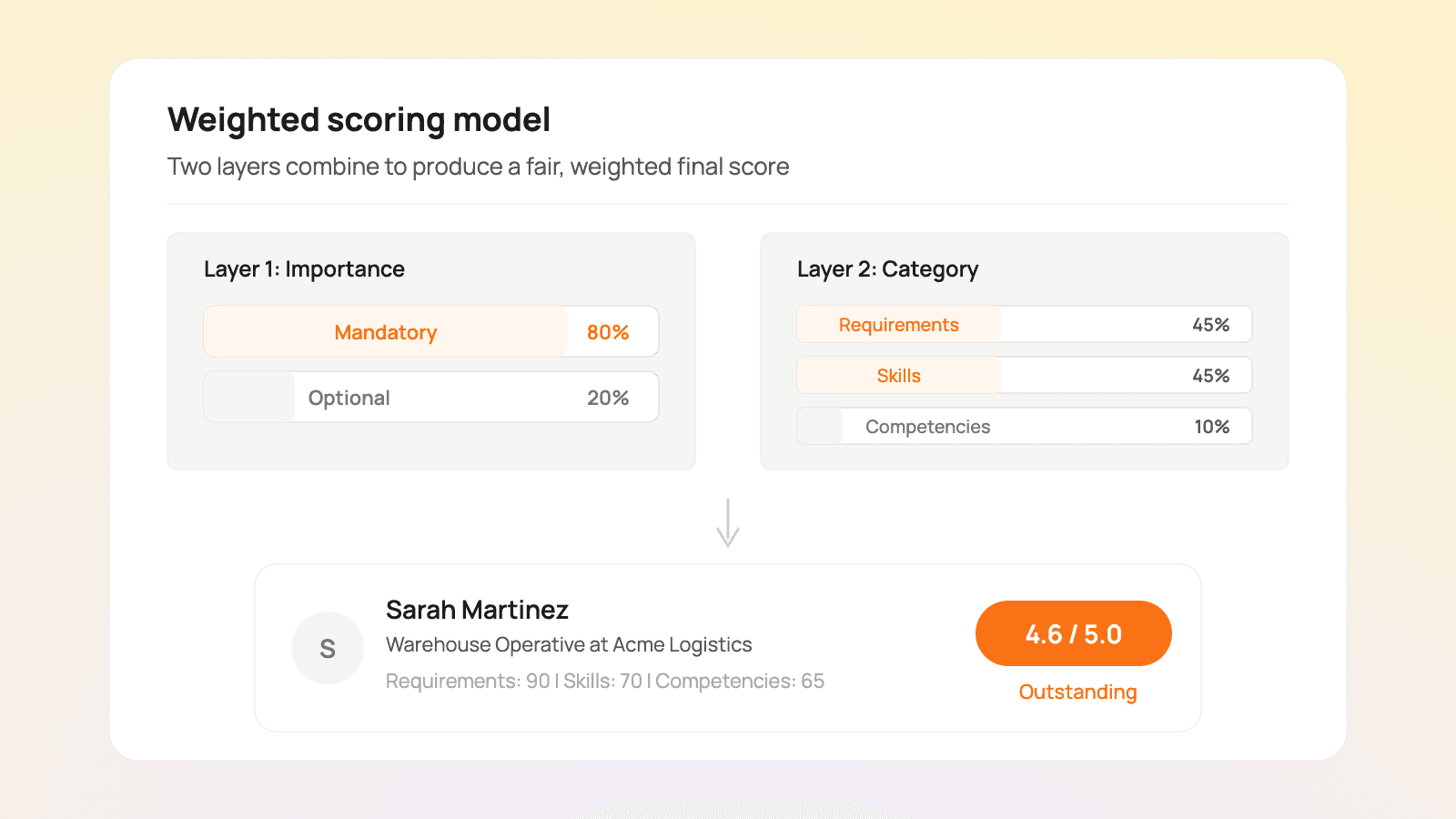
Clara AI applique un système de pondération à deux niveaux pour résoudre cela :
Couche d'importance - Les critères obligatoires représentent 80% du score, les critères optionnels 20%
Couche de catégorie - Les exigences comptent pour 45% du poids, les compétences pour 45%, et les aptitudes pour 10%
Considérez Sarah, une candidate pour un poste d'opératrice de dépôt chez Acme Logistics. Elle obtient un score de 90 pour la certification obligatoire de cariste (Exigences), 70 pour le logiciel de gestion d'inventaire (Compétences), mais seulement 50 pour une certification optionnelle de secourisme. Le système de pondération garantit que sa bonne performance sur l'exigence obligatoire détermine le score final, plutôt que d'être pénalisée par un manque optionnel.
C'est la différence entre un filtre et une évaluation. Les filtres éliminent. Le moteur de Clara AI évalue, pèse et classe.
Du score à la liste restreinte : comment la classification offre aux recruteurs un point de départ clair
Voici la version révisée avec le système d'étoiles retiré, ne gardant que les étiquettes de produit :
Le calcul pondéré produit une classification finale, associée à un résultat clair et lisible par un humain :
Exceptionnel: Performance exceptionnelle à travers les compétences principales
Très Bon: Correspondance forte avec les exigences clés
Bon: Bonne adéquation, répond aux attentes
Moyen: En dessous des attentes dans des domaines importants
Faible: Lacunes significatives dans les compétences principales
Insuffisant: Ne répond pas aux exigences obligatoires
Les recruteurs voient la classification de chaque candidat, leur répartition par compétence, et un résumé écrit structuré expliquant comment Clara a tiré sa conclusion.
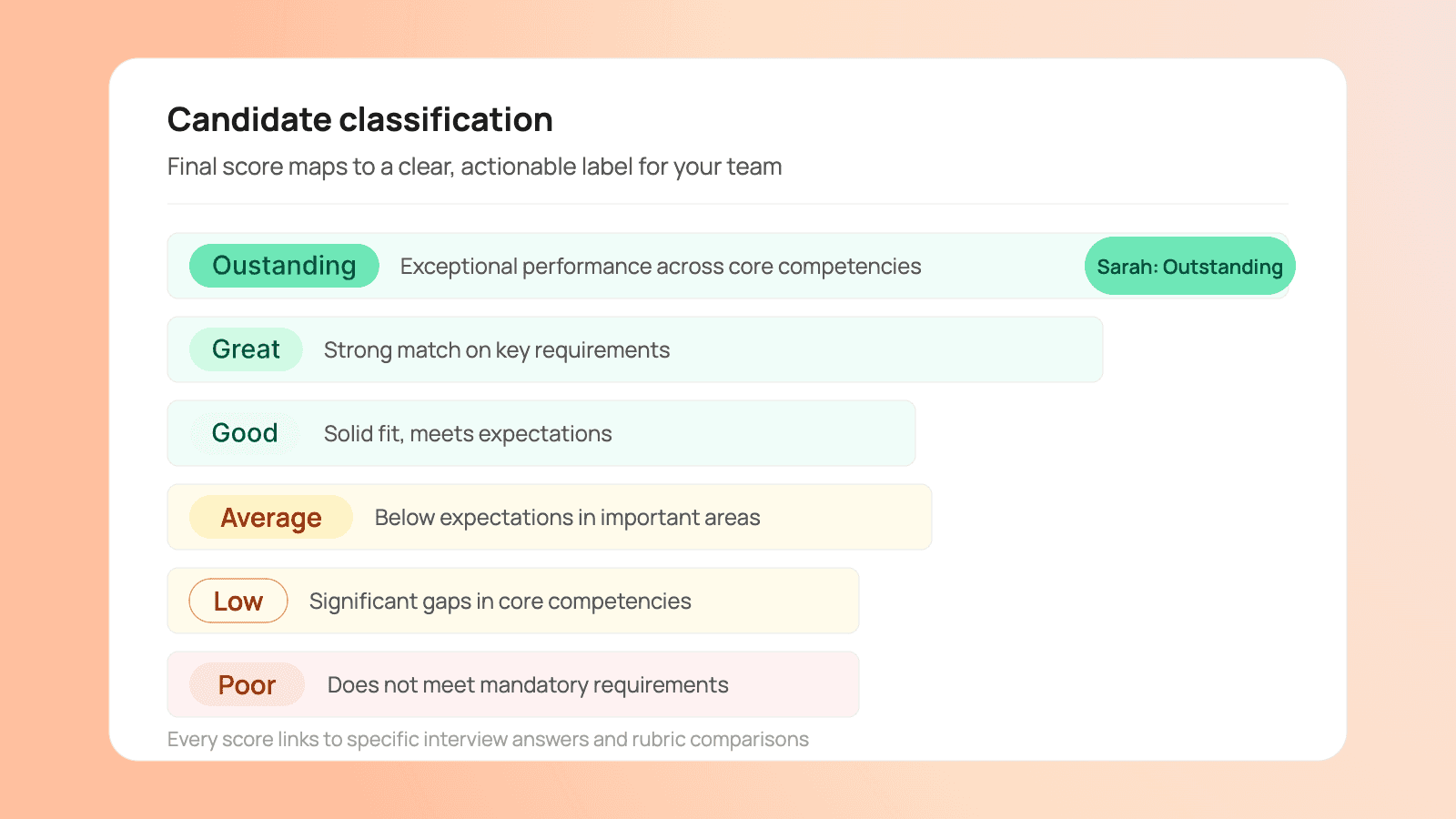
Chaque résultat est explicable. Chaque résultat est lié à des réponses spécifiques, mesurées par rapport à un barème défini.
Pour une équipe recrutant 50 opératrices de dépôt, cela signifie d'ouvrir le tableau de bord de Clara pour trouver des candidates déjà interviewées, classées et cotées.
Au lieu de passer des jours à examiner des CV et à organiser des entretiens de première sélection, ils passent en revue des rapports structurés et décident de qui faire avancer.
Le recruteur prend la décision finale. Clara gère le volume.
Ce que cela signifie pour votre équipe de recrutement
Le moteur principal permet aux recruteurs d'économiser environ 15 à 20 heures par poste sur le dépistage et l'évaluation des premières étapes. Pour les équipes recrutant simultanément à travers plusieurs postes, cela fait la différence entre embaucher un autre coordinateur et tirer plus de vos collaborateurs actuels.
Le temps précédemment dévolu à lire des CV, à planifier des appels, et à rédiger des notes est désormais consacré à rencontrer les candidats présélectionnés, à préparer les managers de recrutement aux entretiens, et à prendre de meilleures décisions plus rapidement.
Le moteur principal de Clara AI est accessible à tous les utilisateurs.
Inscrivez-vous à Clara AI aujourd'hui et obtenez 10 entretiens gratuits.
Entretien
Explore more articles



EN SAVOIR PLUS
Voulez-vous recruter mieux, plus vite ?
Clara se déploie rapidement et recrute encore plus vite. Réservez une démo pour en savoir plus.